Archery Safety for Kids and Beginners
By BowCraft Archery — November 20, 2026

Is archery safe for kids and beginners? How range rules, correctly sized bows, certified instructors and insurance make archery a low-risk sport in Roseville, CA.
If you are asking "is archery safe for kids and beginners," you are asking the right question first. Archery is a stationary sport where the child controls the bow, the arrow only travels when released, and every shot happens at a known target in a known direction. That structure is why archery is widely considered one of the lower-risk youth sports — the risks that do exist are almost entirely managed by rules and supervision, not luck.
Key takeaways
- Archery's injuries are rare and mostly minor (string slap, blisters, fatigue) because the activity is stationary and the range is controlled.
- Safety is layered: range rules and whistle commands, correctly sized equipment, certified background-checked instructors, and insurance.
- Kids as young as about 6–8 can start with lightweight bows, but readiness matters more than age — follow the instructor's assessment.
- A good program provides bows, arrows, arm guards, finger tabs, targets, eye protection and a safety orientation; you don't need to buy gear first.
Is archery safe for kids and beginners?
Yes — archery is statistically one of the lower-risk youth sports, and beginners are not exposed to more danger than experienced archers because the safety system is the same at every level. The sport is stationary, shooting happens in one direction at a controlled target, and instructors can see every archer at once. Compare that with a sport where children run, collide and fall at speed.
Most archery injuries that do occur are minor: a string slap on the forearm (prevented by an arm guard), sore fingers (prevented by a finger tab), and muscle fatigue from shooting too long. Serious injuries are rare and almost always trace back to a broken rule — someone walking onto the shooting line, a bow that was too heavy, or equipment that wasn't checked.
Here is a rough relative picture. The numbers below are an illustrative example, not real statistics, but they show how archery compares to sports parents commonly consider safe or normal.
The point is not a precise number. The point is that archery's risk is front-loaded into preventable mistakes, and those mistakes are exactly what a structured program is built to catch.
How do range rules and whistle commands keep everyone safe?
A whistle-and-command system turns a group of beginners into a predictable, safe line: everyone shoots, everyone stops, everyone retrieves arrows together, and no one moves until told. This is not bureaucracy — it's the single most important safety feature of any archery range, indoor or outdoor.
The standard commands you'll hear at most ranges are:
- "Archers to the line" — walk up and get ready; bows stay down until you're on the line.
- "Shoot" (or one whistle) — you may draw and release.
- "Cease fire" (or two whistles) — stop immediately, even mid-draw. Lower the bow.
- "Retrieve" (or three whistles) — only now does anyone walk toward the targets.
The rule beginners forget is the simplest one: never step past the shooting line to look at a target while anyone is still shooting. A worked example makes it concrete. Picture a birthday party of twelve kids at a mobile setup in a Sacramento park. An instructor assigns four archers to shoot while eight wait behind the waiting line. A whistle stops all four at once. Only after the last bow is set down and the instructor confirms the range is clear do the eight walk forward. No individual decides when it's safe — the range does.
Does equipment sizing (draw length and draw weight) matter for safety?
Yes — equipment that doesn't fit is the most common preventable cause of beginner discomfort, and matching draw length and draw weight to the child is what lets them shoot accurately and comfortably instead of straining. Two terms are worth knowing:
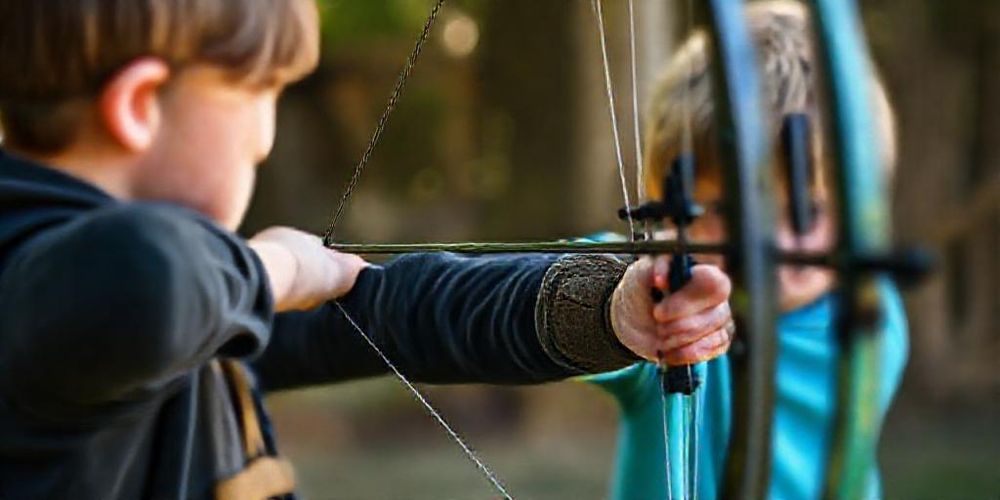
- Draw weight is how many pounds of force it takes to pull the bowstring back to the shooting position.
- Draw length is the distance the string moves back, roughly matched to the archer's arm span.
A bow that's too heavy forces a child to use their whole body to pull, which ruins aim and tires them in minutes. Too long a draw length pulls the string into the face or arm. Here's the working scale most beginner programs follow; a good instructor adjusts it after watching the first few shots.
Archer's age: 6–8 — Typical beginner draw weight: 8–12 lb — Watch for: Fatigue after ~15–20 minutes; short sessions
Archer's age: 9–11 — Typical beginner draw weight: 10–15 lb — Watch for: Poor posture from over-heavy bows
Archer's age: 12–14 — Typical beginner draw weight: 15–25 lb — Watch for: Wanting to jump to a "real" bow too early
Archer's age: 15+ / adults — Typical beginner draw weight: 20–30 lb — Watch for: Skipping the warm-up and getting string slap
These ranges are a starting point, not a rule that overrides observation. A common mistake parents make is buying a heavy bow for a child who will "grow into it" — that's the opposite of safe. In a good class, the instructor fits each archer, watches the first shots, and swaps equipment if needed.
What's provided / what's included
For beginners, everything needed to shoot safely should come with the lesson — you should not have to buy gear to find out whether your child likes archery or to shoot your first arrow. Ask any program to confirm this list before you book.
- Bows sized to each archer's draw length and weight
- Arrows matched to the bows
- Arm guards to prevent string slap
- Finger tabs to protect the string hand
- Targets and a safe backstop behind them
- Eye protection, where the program uses it, plus a checked range
- A safety orientation before the first shot
If a program can't tell you what's included, that's your first clue about how seriously it takes beginner safety.
Who supervises, and is it all insured and certified?
Safety comes down to the people running the line: certified instructors who are background-checked and covered by insurance are what turn range rules into lived practice, and that paperwork is the part you should be able to ask about directly. "Certified" should mean a recognized archery instructor certification, not just someone who shoots well. "Background-checked" means the adults working with your children have been screened. "Insured" means the business carries liability coverage for its lessons and events.
Three sensible questions before you book:
- What certification do your instructors hold, and are they background-checked?
- Can you confirm you carry liability insurance for lessons and mobile events?
- How many instructors supervise how many archers — especially at a party?
A program that answers those plainly, without hedging, is showing you its safety culture. A program that can't is asking you to take a risk on trust alone.
Is archery safe indoors, in Sacramento weather, and at schools or homes?
Yes — archery works indoors regardless of weather, and a properly set-up indoor or mobile range with a backstop is as safe as a permanent outdoor one. In the Sacramento and Placer County area, summer heat and winter rain both push activities indoors, which is one reason archery is dependable for school programs, birthday parties and team events.
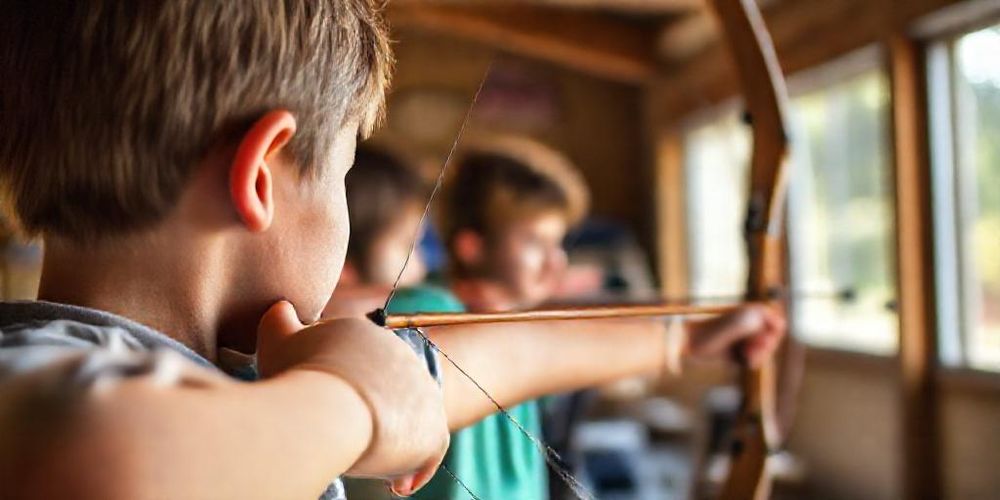
What a safe indoor or mobile setup needs is the same everywhere:
- A clear shooting direction with a backstop behind the targets
- A marked shooting line and a waiting line
- Enough space that no one walks in front of the line
- Instructors who control who is on the line and when
That's why mobile archery works for schools, parks and large events: the range comes to the space, and the rules come with it. If you're comparing programs for a young beginner, our guide to how to choose archery lessons in Roseville, CA covers what to ask beyond safety alone.
Where does archery fit for kids with special needs or first-time adults?
Archery suits a wide range of ages and abilities because it can be done seated or standing, at your own pace, with as much or as little instruction as you want. It's often a good fit for students who find fast team sports overwhelming — the archer shoots alone on the line while the instructor stands beside them.
For first-time adults, the same layered system applies: correct draw weight, a safety orientation, and an instructor watching the first shots. There's no separate "beginner risk" — you start where a child starts, with a light bow and clear rules.
Where can you try archery in Roseville, Sacramento and Placer County?
If you're in the Roseville, Sacramento or Placer County area, you can try archery at a dedicated range in Roseville, at indoor venues, or through a mobile session brought to your school, park or home — and the safety practices described here apply at all of them. BowCraft Archery runs a range in Roseville and offers mobile archery; ask the program where it teaches and travels before you book. Ask what the lessons cover and whether the focus is instruction, equipment, or both. Ask whether instructors are certified and background-checked, and whether they have experience working with children and students with special needs. You can read more about our approach on our safety page and see lesson options across Roseville and Sacramento.
A practical next step is to ask about the age minimum, the draw weight your child will start with, and what's included — then let the instructor watch the first few shots and adjust. That's the whole safety system in action, and it's why first-timers rarely leave an archery session worried.
Book a kids' archery lesson in Roseville through our kids' program, and we'll size the bow, walk through the range rules, and get your child shooting safely on the first visit.
FAQ
What age can kids start archery?
Many children are ready around age 6 to 8, but readiness matters more than a birthday — a child who can follow a whistle command and keep their bow pointed downrange is ready, regardless of exact age. Ask the program for its stated minimum and how it assesses a new archer. Instructors will usually let a younger child try and adjust from there.
What draw weight should a child start with?
Beginners typically start around 8–12 lb at ages 6–8, 10–15 lb at 9–11, and 15–25 lb at 12–14, with adults around 20–30 lb. These are starting points: a good instructor watches the first shots and swaps equipment if the child strains. Never buy a heavier bow for a child to "grow into" — fit first.
Is archery safe indoors?
Yes — a properly set-up indoor range with a backstop, a marked shooting line and a waiting line is as safe as an outdoor range. Indoor archery is especially useful in the Sacramento region when heat or rain rules out the park. The key is the same as outdoors: no one moves forward until the instructor confirms the range is clear.
What do parents have to sign?
Expect a liability waiver and, for a child, a parental consent form listing emergency contacts and any medical notes. Programs may also ask about allergies or accessibility needs. Ask for the waiver before the day so you can read it at home — a program should be happy to send it.
Are archery instructors certified and insured?
They should be: ask what certification they hold, whether they are background-checked, and whether the business carries liability insurance for lessons and mobile events. A program that answers these clearly is showing its safety practices, not just promising them. This is the single best question to ask before booking.
Is archery safe for adults who've never tried it?
Yes — adults start under the same system as children, with a light bow sized to them, a safety orientation and an instructor watching the first shots. The main adult mistake is skipping the warm-up or grabbing a heavy bow too soon. Follow the range commands and you're in one of the least risky sports to try.