Your First Archery Lesson: A Walkthrough
By BowCraft Archery — November 23, 2026

Nervous about your first archery lesson? Walk through a real 90-minute beginner class hour by hour, from waiver to first bullseye, in Roseville, Sacramento and Placer County.
If you've typed "what to expect at your first archery lesson" into a search bar at 11 p.m., you're not alone—and you're already doing the right thing. Ask the provider how long its beginner lessons run and what the session covers; at BowCraft, ask when you book. Here's the short version: ask what a beginner lesson covers when you book—many include a waiver, a safety briefing, and close-range shooting with a coach guiding you and gear provided. No experience, no gear, and no athletic background required.
That's the whole arc. The rest of this guide fills in the hour by hour so the unknown gets smaller. It's written for the greater Sacramento area—Roseville, Rocklin, Granite Bay, Folsom, and the wider Placer County side—because that's where BowCraft Archery teaches, both at its Roseville range and through mobile lessons. Ask about the service area and options when you book.
One note before we start: this walkthrough is a general picture, not a contract. Every instructor runs a class a little differently, and times shift depending on group size. Use it to know what's coming, not to grade your coach against a stopwatch.
Key takeaways
- An intro lesson typically covers safety, stance and draw drills, and close-range shooting—confirm the schedule and how much live shooting it includes with the provider before you book.
- Bring what the provider tells you to bring; confirm what gear is included and what you need to supply yourself when you book—typically closed-toe shoes and water are a good bet, but ask.
- "Certified and background-checked" is a claim worth asking about directly—ask which certification and how often background checks are renewed.
- You don't need to be strong, coordinated, or "sporty." Beginner bows are light, and the first distance is deliberately short.
- Book based on venue and weather: ask whether the range is indoor and how the provider handles rain, wind, and hot Sacramento afternoons.
What should I expect at my first archery lesson, hour by hour?
Expect a structured session that starts slow and speeds up: time on arrival and paperwork, a safety briefing, stance and draw drills, and close-range arrows. A typical beginner lesson may run around an hour—ask the provider how long its class lasts and how the time is split. The pace is deliberate on purpose—archery rewards setup, and a good instructor front-loads the boring-but-important parts so the shooting feels easy later.
Here's the sequence, in the order you'll actually do it. A few terms first, so nothing surprises you:
- Nock: to place an arrow's slotted end onto the bowstring.
- Anchor point: the spot on your face or jaw where your drawing hand rests the same way every shot.
- Shooting line: the painted or taped line you stand behind while shooting.
- Stretch band: a rubber loop used to practice draw and release motions without a bow or arrow.
Step 1: Arrival and waiver (minutes 0–15)
Plan to arrive 10–15 minutes early. You'll check in, get a quick tour of the range or park setup, and sign a liability waiver—a form acknowledging you understand the risks of shooting sports. Minors need a parent or guardian signature; if you're booking for a child, confirm in advance whether the parent must be present or can sign digitally.
Ask two questions here if you care about them: who is teaching today, and what certifications do they hold? A professional program should answer both without flinching.
Step 2: Safety briefing (minutes 15–30)
This is where nerves usually settle, because the rules are simple and everyone hears them together. You'll learn the range commands—usually something like "bows down," "shoot," and "retrieve"—plus the big three: never point a bow at a person, keep arrows pointed downrange at all times, and only go past the shooting line when the instructor calls a cease-fire.
You'll also get fitted for basic gear: an arm guard (a plastic or leather shield that protects your forearm from the string), a finger tab or glove, and a bow sized to your height and draw length. If anything pinches or feels awkward, say so—beginners almost never complain about fit, and they should. For a deeper pass on range rules, BowCraft's guide to archery safety for kids and beginners covers the same ground the briefing does.
Step 3: Stance and draw drills with stretch bands (minutes 30–50)
You'll practice the shot motion without shooting anything. Most instructors start you in a square or slightly open stance—feet about shoulder-width, body turned partly sideways to the target—then walk you through the draw, anchor, and release with a stretch band. Some coaches add a string bow, a training tool that mimics a bow's feel without the power.
This is the awkward part, and it's supposed to be. Your first few band draws will feel like patting your head and rubbing your belly. By the tenth one, it clicks. The goal isn't perfect form—it's a repeatable motion so that when a real arrow goes on the string, you already know what your body is doing.
A blunted arrow, by the way, is one with a flat, non-penetrating tip used for close-range practice or certain events. You may see them in junior programs; beginners typically shoot standard field points from the start. For how bow types differ, and why beginners usually start on a light recurve, see the linked comparison below rather than expecting a deep dive here.
Step 4: Your first arrows at close distance (minutes 50–70)
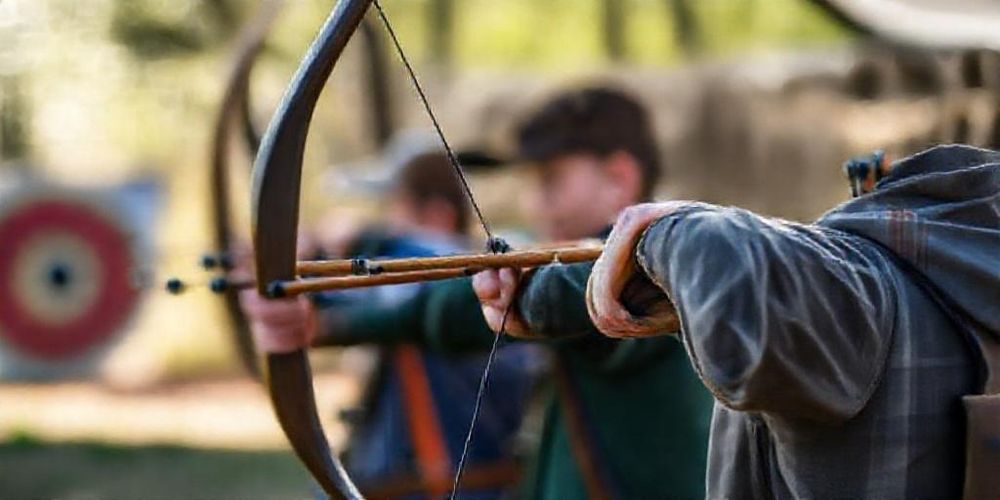
Now you shoot. Nearly every program starts beginners a few yards from the target—sometimes closer. The distance is short so your first shots land somewhere satisfying, not in the backstop.
You'll shoot in small rounds, a few arrows at a time, with the instructor standing nearby to adjust your anchor or remind you to follow through. Expect at least one shot that surprises you and one that goes wide. Both are normal. If you've ever wondered whether you'll be the worst one there, here's a better way to think about it: everyone in the room is a beginner, and the person next to you is quietly worried about the same thing.
Step 5: Wrapping up the session
If the group is moving well, you may get to shoot a few final rounds. Ask the provider ahead of time how far beginners shoot and how the session ends. Many instructors close with a short game or a little friendly scoring, and some programs hand out a certificate or token for younger shooters.
You'll finish by helping with a quick cleanup—pulling arrows as a group, coiling bands—and the instructor usually wraps with what to practice next and when to come back.
Time: 0–15 min — What you're doing: Arrival and waiver — What it feels like: Paperwork, a little small talk
Time: 15–30 min — What you're doing: Safety briefing and gear fitting — What it feels like: Attentive; nerves start to calm
Time: 30–50 min — What you're doing: Stance and draw drills with stretch bands — What it feels like: Awkward, then repeatable
Time: 50–70 min — What you're doing: First arrows at close distance — What it feels like: Surprising, satisfying, sometimes wide
Time: Final minutes — What you're doing: Wrap-up and next steps — What it feels like: Genuinely like archery
What's included, what to bring, and how do I compare lesson providers?
Most reputable beginner programs include all gear, insurance, and instruction; the real differences are price transparency, instructor credentials, and whether the venue holds up in bad weather. Those three are where a nervous beginner gets burned, so check them before you pay.
The table below lays out what to expect and what to ask. The right-hand column lists questions to confirm when you book, since group and mobile setups vary.
Item: Bows, arrows, targets — What to expect from a good provider: Included, sized to the shooter — How BowCraft handles it: Ask what the package includes when you book
Item: Arm guard, finger tab/glove — What to expect from a good provider: Included for beginners — How BowCraft handles it: Ask what the package includes when you book
Item: Insurance and waivers — What to expect from a good provider: Current liability coverage; written waiver — How BowCraft handles it: Ask how waivers are handled and what coverage applies
Item: Instructor credentials — What to expect from a good provider: Named certification; background checks — How BowCraft handles it: Ask which certification and background checks apply when you book
Item: Transparent pricing — What to expect from a good provider: Published rates, no surprise fees — How BowCraft handles it: Ask for current rates and any extra fees before booking
Item: Venue — What to expect from a good provider: Indoor or covered option regardless of weather — How BowCraft handles it: Ask whether the range is indoor when you book
Item: Group and mobile service — What to expect from a good provider: On-site or mobile options — How BowCraft handles it: Ask about group and mobile options when you book
Item: Special needs support — What to expect from a good provider: Experienced staff, flexible pacing — How BowCraft handles it: Ask how the provider accommodates students with special needs
Item: Equipment sales — What to expect from a good provider: Optional — How BowCraft handles it: Ask whether equipment is sold or only provided for lessons
On credentials: "certified" can mean many things, and that's not a dodge—it's just true. Instructor certification programs include USA Archery's coach levels and other national and state-level training pathways, and they differ in what they require. Rather than take any provider's word for it (including ours), ask which certification, who issued it, how background checks are run, and how often they're renewed. California's Department of Justice runs the state's background check system for many employment and volunteer contexts, and the California DOJ background check pages explain how those checks work if you want to understand what a provider means when they say "checked."
By the time you're comparing providers, it's worth reading a fuller breakdown of how to choose archery lessons in Roseville, CA—it covers pricing structures and trial-class questions this article doesn't have room for.
One more comparison worth naming honestly: free online tutorials. YouTube is great for understanding terms and watching form, but it can't call a cease-fire, fit your bow, or correct the anchor you can't see yourself. Treat video as homework and a live lesson as the class. Dry-fire mistakes (drawing and releasing a bow without an arrow) are a good example—dangerous, easy to do alone, and covered in our own FAQ-style material rather than pretending video is a substitute for a coach.
Where do lessons happen around Roseville and Sacramento—and what if it rains?
Lessons happen either at a dedicated indoor range or on mobile setups; ask the provider which venues it uses and whether its indoor option keeps classes going in rain, wind, and heat. In the Sacramento region, that matters more than most beginners realize, because the same valley that gives you mild winters also delivers summer afternoons hot enough to make an outdoor class miserable.
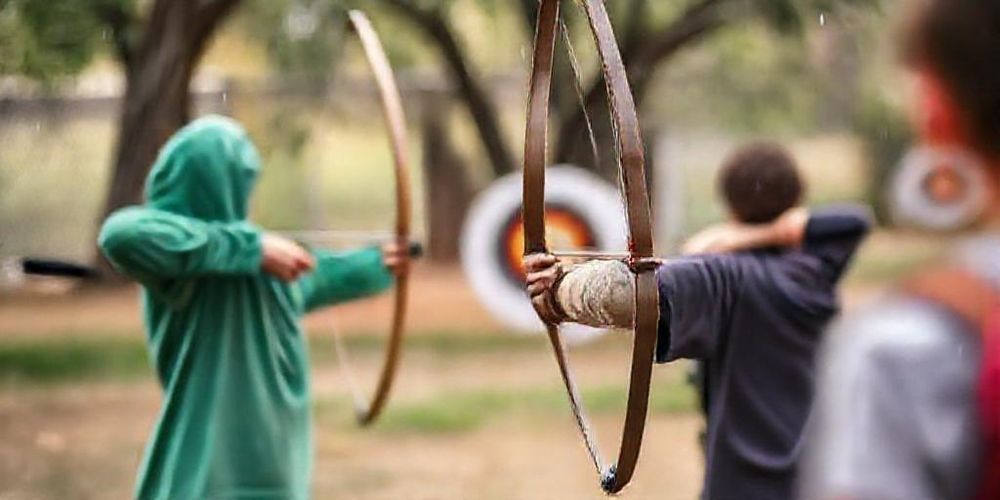
BowCraft teaches at its archery range in Roseville—ask when you book whether the range is indoors and how lessons are handled in bad weather. The company also lists a mobile archery option; ask what areas it serves and what group sizes it accommodates. If you're in Rocklin, Granite Bay, or Folsom, ask whether mobile service reaches you—it can be the difference between a short drive and none at all.
Compare that fairly against the alternatives. Outdoor ranges and clubs offer real distance and a club atmosphere, but they're exposed to weather and often run on volunteer schedules. Pro shops with lessons can be excellent and have deeper equipment knowledge—which is a genuine advantage worth weighing, so ask what each pro shop offers. Big-box intro classes are inexpensive and convenient, but they tend to be short and generalized. Mobile party providers are fun-first, which suits a birthday and less so a first-timer who wants to actually learn.
That's the honest split: if you want to buy a bow the same day, a pro shop is your best bet. If you want a training-focused facility, ask about credentials, insurance, and what's included when you book; those are the parts that matter.
Indoor vs. outdoor vs. mobile at a glance
- Indoor range in Roseville: often best for first lessons, kids' programs, and any date where weather could ruin the plan—confirm the venue when you book.
- Outdoor range or club: best for archers who already have basics and want distance, league play, or a club community.
- Mobile setup: ask what the provider offers for groups where travel would thin the crowd.
- Online tutorials: best as a supplement—useful for vocabulary and preparation, not for your first real shot.
FAQ
Will I be the worst one there?
Almost certainly not, because there's no ranking on day one. Beginner classes are built around first-timers, instructors correct everyone, and your neighbors are nursing the same worry. The person who "wins" the first lesson is usually just the one who asks the most questions.
Do I need to be strong or athletic?
No. Beginner bows have light draw weights, and the first distance is short. If you can lift a gallon of water comfortably, you can draw a starter bow—and the stretch-band drills exist precisely so you don't have to muscle anything.
What should I wear and bring?
Closed-toe shoes, a shirt that won't catch the string (avoid loose, dangling sleeves), and a water bottle. Tie back long hair and remove dangling jewelry or lanyards. Leave the rest at home—gear should be provided, and ask when you book whether you need to buy anything.
Is archery safe for kids and for students with special needs?
Archery has a strong safety record when rules are followed, and it's one of the few sports that adapts well to different ages and abilities. Ask any provider how they pace instruction for children or students with special needs—small-group size, one-on-one support, and flexible distance adjustments are the things to look for.
Can I pay with a voucher or Groupon?
Some providers accept vouchers and deal platforms; policies vary by business and change over time. Confirm the voucher terms directly with the provider before you book, including whether it covers a specific class type and how far ahead you need to reserve.
What happens after my first lesson?
Most people leave with two or three specific things to practice and a sense of whether they want to continue. Ask your instructor what the next class covers and how often they recommend shooting—once a week is plenty for a beginner—and you'll leave with a plan instead of a vague intention.
Your first lesson is mostly logistics and reassurance: show up early, wear closed-toe shoes, listen to the briefing, and let the awkward band drills do their work before your first arrow flies. If you'd rather not leave anything to chance, booking ahead at a dedicated indoor range means weather, gear, and instructor credentials are already settled. Book your first lesson in Roseville today, and the nerves can stay home.
Groups and parties: ask whether charter school programs and birthday celebrations run through separate booking pages, so families and schools can go straight to the right form.